
Master key system installation in Philadelphia
If you manage a commercial building, an apartment complex, or a multi-unit property in Philadelphia, there’s a good chance your key situation is already out of control. You have a drawer full of keys with no clear record of who has copies. A tenant moved out three years ago and may still have a key. Your maintenance guy carries seven keys for seven different doors and regularly locks himself out of the wrong one. The building works, technically, but nobody actually controls who has access to what.
That’s the problem a master key system solves. At Ben Locksmith Philadelphia, we design and install master key systems for commercial buildings, apartment complexes, offices, schools, and industrial facilities across the city. Call +1 267-585-6033 to schedule a consultation or request a commercial quote.
For a full overview of our commercial services, visit our commercial locksmith Philadelphia page.
The situations that make people call us
You just took over a building with no key records: This is one of the most common calls we get, especially from property managers and landlords who purchased a multi-unit property in West Philly, Germantown, or Kensington. The previous owner handed over a set of keys with no documentation. You have no idea how many copies exist or who has them. A master key system lets you start clean, with a documented hierarchy and controlled duplication from day one.
Your staff is carrying too many keys: A property manager running a 20-unit building shouldn’t need 20 keys. A school administrator shouldn’t need a different key for every classroom, office, and utility closet. A master key system collapses that into a single key at the appropriate access level, with lower-level keys for people who only need access to specific areas.
You had a security incident and don’t know how it happened: No forced entry, no broken locks. Someone got into a restricted area who shouldn’t have been there. When key accountability is loose, this kind of incident is almost impossible to trace. A properly documented master key system with restricted keyways makes unauthorized duplication significantly harder and gives you a paper trail.
You’re managing tenant turnover and rekeying is getting expensive: If you’re rekeying individual units every time a tenant leaves without a structured system underneath, you’re spending money that a well-designed master hierarchy would eliminate. Individual units can be rekeyed during turnover without touching the master level at all.
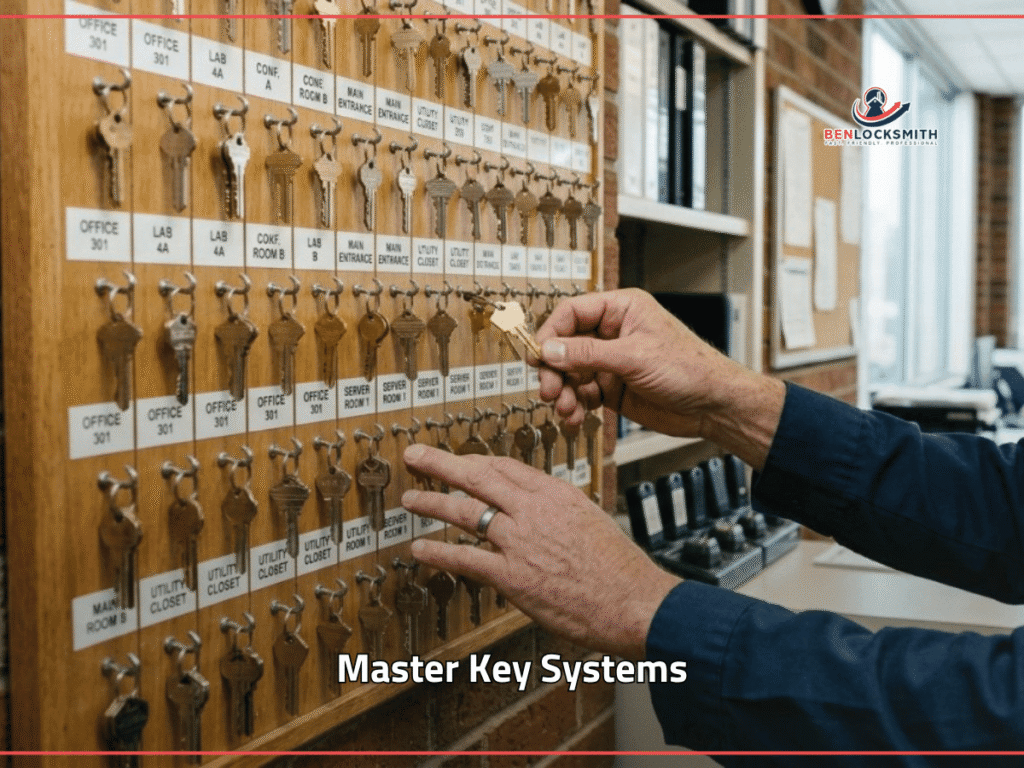
Master key vs access control: which one do you actually need
This is the question most locksmith pages avoid answering because they want to sell you whatever they install. Here’s the honest version.
A master key system is mechanical. It works with traditional locks, requires no power, no software, and no ongoing subscription. It’s the right choice for buildings where you need differentiated access levels but don’t need to track individual entry events or manage credentials remotely. It’s also significantly less expensive upfront and easier to implement in older Philadelphia buildings with non-standard door frames or limited electrical infrastructure.
Access control is electronic. It gives you entry logs, remote credential management, and the ability to deactivate a credential instantly from your phone. It’s the right choice when you need accountability down to the individual and the timestamp, when you have high staff turnover, or when you’re managing a facility with compliance requirements around access monitoring.
Many buildings use both: a master key system for areas where mechanical access is sufficient, and electronic access control on doors where logging and remote management matter. We’ll give you an honest assessment of which approach fits your building after we walk through it. You can also read more about the electronic side on our access control systems page.
How a master key system actually works
The system is built around a key hierarchy. Each level opens more doors than the one below it.
A change key opens only one specific lock. This is what a tenant or a line employee carries. It gives access to their space and nothing else.
A sub-master key opens a group of locks. A floor supervisor might carry this. It opens every door on their floor or in their department, but nothing outside of that.
A master key opens everything within a system. A building manager or head of security carries this. One key, full access.
A grand master key sits above that, opening multiple master key groups. Used when you’re managing several buildings or large institutional campuses where different master systems need a single key above them.
The locks themselves are configured at the cylinder level to accept multiple key cuts without compromising the hierarchy. A change key for unit 4B will never accidentally open unit 4C, even within the same system.
Restricted keyways: why they matter
Standard keys can be duplicated at any hardware store. That’s the core vulnerability of any traditional key system, master or otherwise. A restricted keyway closes that gap.
With a restricted keyway, the key blank is proprietary and only available through authorized distributors. A tenant who wants an extra copy can’t walk into a hardware store and get one cut. They have to come through the building manager, which creates accountability and a record.
We work with restricted keyway systems regularly and recommend them for any master key installation in a multi-tenant building or facility with sensitive areas. The cost difference is modest. The security improvement is substantial.
What happens if a master key is lost
This is the question that makes building owners nervous about master key systems, and it deserves a direct answer.
A lost master key is a serious situation but not a catastrophic one when the system was designed correctly. Because the master key opens every lock in the system, a compromised master means the entire cylinder hierarchy needs to be rekeyed or replaced to restore integrity. That sounds expensive, and it can be, which is why we design systems with this scenario in mind from the start.
Specifically, we recommend keeping master key issuance to the absolute minimum number of people who genuinely need it. We also document every key issued, at every level, from day one. If a master is lost, we can rekey the affected cylinders and reconfigure the system without rebuilding it from scratch. The cost depends on the size of the system, but most rekeying operations for a mid-size commercial property run between $300 and $900.
The worst-case scenario for a lost master key almost always traces back to a system that was issued too broadly in the first place. We help you avoid that from the design stage.

Need a professional master key system? Give us a call
Whatever your locksmith needs, we’ve got you covered.
Philadelphia buildings and what makes them different
A significant portion of master key system work in Philadelphia happens in buildings that weren’t designed with structured key management in mind. Rowhouses converted to multi-unit rentals in West Philly and Germantown. Pre-war commercial buildings in Old City and Center City with original door hardware. Industrial facilities in Kensington and Port Richmond with mismatched locks accumulated over decades.
In older buildings, cylinder compatibility is often the first challenge. We assess what’s already installed and determine what can be incorporated into the new system versus what needs to be replaced. In many cases we can rekey existing cylinders into the master hierarchy without replacing the entire lockset, which reduces cost significantly. You can learn more about that process on our lock rekeying page.
When full replacement is necessary, we recommend hardware that matches the door profile and meets current security standards. More on that on our lock replacement page.
What Does a Master Key System Cost in Philadelphia?
Master key system pricing depends on the scope of the system, the hierarchy you need, and what your building actually requires — and it’s one of the services where an accurate number genuinely isn’t possible without a walkthrough.
What drives the cost is the number of doors, how many levels of access the system needs to support, whether restricted keyways are required to prevent unauthorized key duplication, and how much of your existing hardware can be incorporated versus replaced. A small office with a straightforward two-level system is a fundamentally different job than a multi-building institutional setup with a full grand master hierarchy.
What affects the cost of a master key system?
Number of doors. The baseline of any system. Every door in the hierarchy adds hardware, keying, and configuration to the scope.
Levels of access. A simple master and change key setup is different from a system with sub-master levels, department keys, and a grand master — each additional tier adds complexity to the design and the installation.
Restricted keyways. If controlling unauthorized key duplication is a priority — and for most commercial clients it should be — restricted keyway systems require specific hardware and add to the overall cost.
Existing hardware compatibility. Some buildings can incorporate their current locks into the new system. Others require full hardware replacement. We assess that during the walkthrough.
Expansion of an existing system. Adding doors to a system that’s already in place is a different scope than building from scratch — and whether the existing system can accommodate the expansion cleanly affects the price significantly.
Lost master key situations. When a master key is lost or compromised, the system needs to be rekeyed to restore security. The scope of that work depends on the size and complexity of the existing system.
Frequently asked questions
Can you work with the locks I already have?
In many cases yes. We evaluate cylinder compatibility during the assessment. If your existing hardware can accept the new key cuts without compromising security, we incorporate it. If it can’t, we’ll tell you exactly what needs to be replaced and why.
What stops a tenant from duplicating their key?
Standard keyways offer limited protection since blanks are widely available. Restricted keyways address this directly by limiting where blanks can be obtained. For buildings where duplication control matters, we recommend restricted keyways as a standard part of the design.
How many levels of hierarchy do I actually need?
Most multi-tenant residential buildings work well with two or three levels: individual tenant keys, a sub-master for floor or section access, and a building master. Corporate buildings and schools often need three to four levels. We’ll map out the right structure for your specific building during the consultation, not before we see it.
How long does installation take?
A small system of 5 to 10 doors typically takes one to two days. A 20 to 30 door system in a multi-unit building usually runs two to three days depending on hardware compatibility and door conditions.
Can I add more doors to the system later?
Yes, if the system is designed for expansion from the start. We build that into the initial design so that adding a new floor, a new section, or a new building to the hierarchy doesn’t require starting over.
What if I already have a master key system that's become disorganized?
This is more common than you’d think. We do system audits, identify where the hierarchy has been compromised, rekey what needs to be corrected, and document everything cleanly going forward.
Schedule your master key consultation
If your building’s key situation has gotten out of hand, or you’re starting fresh and want to do it right from the beginning, we’re ready to help. Call +1 267-585-6033 or request a commercial quote online.
We also handle lock installation, door lock repair, and commercial lockout service if you’re addressing multiple needs in the same visit.
Ben Locksmith Philadelphia serves commercial and residential properties throughout the city including Center City, Old City, West Philly, Germantown, Kensington, Fishtown, Northern Liberties, South Philly, and Northeast Philadelphia.
Fast response
Average 15-20 minutes response time
Local service
Serving Greater Philadelphia
24/7 Emergency
Always here when you need us