High security locks installation in Philadelphia
Most people don’t think seriously about their locks until something happens. A break-in attempt on their block. A neighbor who came home to a kicked-in door. An insurance renewal that came back with new hardware requirements. Or just the gradual realization that the locks on their front door are the same ones that were there when they moved in, and they have no idea how old they are or how many key copies exist.
If any of those situations brought you here, you’re asking the right question at the right time. At Ben Locksmith Philadelphia, we install high-security lock systems for residential properties, commercial buildings, and multi-unit properties throughout the city. Call +1 267-585-6033 for a security consultation or request a quote online.
For a broader look at our residential or commercial services, visit our residential locksmith Philadelphia page or our commercial locksmith Philadelphia page.
What's actually wrong with your current locks
Most residential doors in Philadelphia are secured with Grade 3 hardware. That’s the standard builder-grade deadbolt and knob set that comes with a property and provides a baseline level of security that an experienced burglar can defeat in under a minute using tools that fit in a jacket pocket.
Grade 3 hardware fails in three specific ways that matter in the real world. First, the cylinders are pick-resistant in name only. The standard pin tumbler mechanism in a Grade 3 lock can be bypassed with basic picking tools or a bump key in seconds. Second, the keys can be duplicated at any hardware store, which means anyone who has ever had a copy of your key can still have a copy of your key. Third, the physical hardware itself, the bolt, the strike plate, the cylinder housing, is made to a price point that prioritizes cost over durability.
High-security locks address all three of those vulnerabilities at the hardware level rather than relying on procedures or habits to compensate for weak equipment.
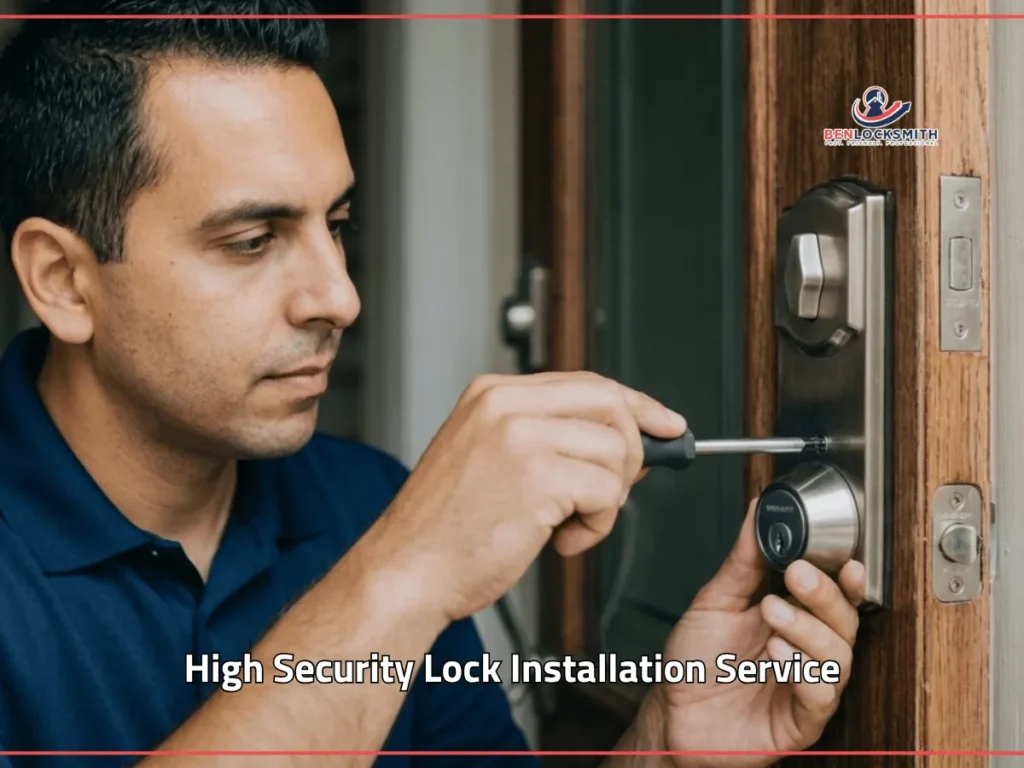
What high-security locks actually do differently
The difference isn’t just marketing language. It’s measurable at the mechanical level.
Cylinder complexity is the first thing. High-security cylinders use sidebar mechanisms, rotating elements, or secondary locking features in addition to standard pin tumblers. These make picking exponentially harder because defeating one layer doesn’t open the lock. A standard Grade 3 cylinder that takes seconds to pick can take an experienced locksmith with professional tools 30 minutes or more to defeat on a high-security cylinder, and an opportunistic burglar with basic tools essentially can’t do it at all.
Drill resistance matters because drilling is the fallback when picking fails. High-security cylinders contain hardened steel inserts and anti-drill plates positioned at the points where a drill bit would otherwise make progress. Drilling into a Medeco or Mul-T-Lock cylinder doesn’t go the way drilling into a standard cylinder goes.
Restricted keyways solve the key duplication problem completely. The key blank for a restricted keyway system is proprietary and only available through authorized distributors. A copy can’t be made at a hardware store, a locksmith not in the authorization chain, or any key-cutting kiosk. If you need a copy, it goes through you and gets documented. That’s meaningful key control rather than the illusion of it.
ANSI Grade 1 hardware means the physical components, the bolt, the strike plate, the housing, are manufactured to the highest standard in the rating system. Grade 1 deadbolts are tested to withstand significantly more force than Grade 3 before failing. In practical terms that means a kicked door or a pry bar attack has to work much harder before the hardware gives way, if it gives way at all.
Need a professional high security lock installation? Give us a call
Whatever your locksmith needs, we’ve got you covered.
Which brand is right for your property
This is where generic content usually fails you by listing names without context. Here’s the practical breakdown based on what we actually install in Philadelphia.
Medeco
Is the benchmark for residential high-security in the United States. The cylinder uses a combination of standard pin tumbler and rotating pin mechanisms that make picking and bumping extremely difficult. The restricted keyway system is well-established and widely respected. Medeco is the right choice for homeowners and residential properties where you want the best available protection at a price point that’s high but not institutional.
Mul-T-Lock
Uses a telescoping pin tumbler system with an inner and outer set of pins that have to align simultaneously. It’s widely considered one of the most pick-resistant cylinders commercially available and is a common choice for commercial properties, high-value residential applications, and multi-unit buildings where key control is a priority. The restricted keyway system is exceptionally tight.
Schlage Primus
Is a strong mid-tier option for commercial applications where you need Grade 1 hardware and meaningful pick resistance without the cost of Medeco or Mul-T-Lock. The secondary locking mechanism adds significant pick resistance over standard Schlage hardware, and the restricted keyway system provides real duplication control. This is often the right choice for commercial buildings that need to upgrade multiple doors without the budget for full Medeco or Mul-T-Lock across every entry point.
ASSA ABLOY commercial systems
Are the choice for institutional and large commercial applications where you need a scalable system across many doors with integration into access control or master key infrastructure. More on that on our access control systems page and master key system page.
We’ll make a specific recommendation after we look at your property, your doors, and what you’re trying to protect. The brand that’s right for a rowhouse in South Philly isn’t necessarily the same one that’s right for a retail storefront in Center City.
The door and frame matter as much as the lock
This is something a lot of security content ignores and it’s the most common mistake people make when upgrading locks. A Grade 1 Medeco deadbolt installed on a weak door frame provides a fraction of the protection it should, because the frame is where most forced entry actually happens. Kicking a door doesn’t usually break the lock. It breaks the frame around the strike plate.
A proper high-security installation addresses the full entry point: the cylinder, the deadbolt hardware, the strike plate with three-inch screws that reach into the door stud rather than just the trim, and the door frame itself if it needs reinforcement. We assess all of these before we recommend hardware, and we tell you if the door or frame needs work before the lock installation will actually achieve what you’re paying for.
For doors that need full hardware replacement alongside the security upgrade, see our lock replacement page and deadbolt installation page.
High security locks installation service across all Philadelphia neighborhoods
We install high-security locks throughout Philadelphia for homeowners and residential property managers looking for stronger protection against common forms of lock manipulation and forced entry.
Center City & downtown Philadelphia
Center City, Rittenhouse Square, Old City, Washington Square West, Midtown Village and Logan Square.
South Philadelphia
Bella Vista, Queen Village, Passyunk Square, East Passyunk, Pennsport and Point Breeze.
North Philadelphia & nearby neighborhoods
North Philadelphia, Fishtown, Fairmount, Northern Liberties, Poplar, Port Richmond, Brewerytown, Olde Kensington, Hartranft, Fairhill, Kensington, Spring Garden and Cecil B. Moore.
West Philadelphia
University City, Powelton Village, Cedar Park and Spruce Hill.
Northeast Philadelphia
Mayfair, Frankford, Tacony, Bustleton and Fox Chase.
Northwest Philadelphia
Manayunk, Roxborough, East Falls, Germantown, Chestnut Hill and Mount Airy.
Philadelphia properties and where this matters most
High-security lock installation comes up in specific contexts in Philadelphia that are worth naming directly.
Rowhouses with original hardware in neighborhoods like South Philly, West Philly, Germantown, and Kensington often have lock hardware that’s decades old and was never high-security to begin with. These properties are also more likely to be rental units with a history of key copies that nobody has tracked. The combination of old hardware and uncontrolled key distribution is about as vulnerable as a property gets.
Commercial properties along busy corridors, retail on South Street, restaurants on East Passyunk, offices in Center City and Old City, are frequent targets of opportunistic break-ins precisely because the volume of foot traffic makes observation easy and escape straightforward. High-security hardware on exterior entries and back-of-house doors changes the risk calculus for someone casing a property.
Multi-unit residential buildings throughout the city benefit from restricted keyway systems because they solve the key duplication problem across an entire building rather than unit by unit. A building master key system built on restricted keyway hardware is significantly more secure than the same system built on standard hardware, and it doesn’t cost dramatically more to implement correctly from the start. More on our lock replacement page.
What Does High-Security Lock Installation Cost in Philadelphia?
High-security lock pricing depends on the brand, the specific product within that brand’s lineup, your door and frame condition, and the scope of the installation and there’s a significant range across all of those variables.
The hardware itself is a serious investment compared to standard locks. Medeco, Mul-T-Lock, Schlage Primus, and similar brands manufacture locks engineered to resist picking, drilling, bumping, and key duplication — and that engineering is reflected in the price. Within each brand, there are different product tiers with different features and price points.
What affects the cost of high-security lock installation?
Brand and product line. Medeco, Mul-T-Lock, Schlage Primus, and other high-security manufacturers each have multiple product tiers. The right choice depends on your specific security priorities and application.
Residential vs. commercial application. Commercial-grade hardware and residential hardware are engineered differently and priced accordingly.
Door and frame condition. A high-security lock is only as strong as the door and frame it’s installed in. If your current setup needs reinforcement — strike plate upgrades, frame reinforcement, or door prep work — that’s part of doing the job right. We’ll tell you what’s needed during the assessment.
Restricted keyway systems. For commercial clients who need to prevent unauthorized key duplication, restricted keyway systems require specific hardware and add to the scope of the project.
Number of doors. Multi-door commercial installations affect both the hardware total and the overall labor scope, and can usually be priced more efficiently than single-door jobs done separately.
Smart high-security combinations. Some installations combine electronic access with reinforced high-security cylinders. You can read more about those options on our smart lock installation service.
Frequently asked questions
My door looks solid. Do I really need to worry about the frame too?
Yes. The majority of forced entries happen by breaking the frame around the strike plate rather than defeating the lock itself. A high-security lock on a standard frame with standard strike plate screws is significantly less effective than the same lock installed with a reinforced strike plate and long screws that reach into the structural stud. We assess both as part of every installation.
Can I upgrade just the front door and leave the other doors as they are?
Yes, and that’s a reasonable approach if your front door is your primary concern. We’ll flag any other entry points that represent obvious vulnerabilities during the assessment so you have the full picture, but the decision about what to address and when is yours.
What happens if I lose a key from a restricted keyway system?
Report it immediately. Because restricted keys can’t be duplicated without authorization, a lost key is a contained problem as long as you act on it. We can rekey the affected cylinders promptly. The restricted keyway system doesn’t eliminate the possibility of a lost key but it does mean that a lost key can’t be duplicated by whoever finds it.
Are high-security locks compatible with smart lock systems?
Some are. Several manufacturers including Medeco and Mul-T-Lock produce models that integrate with electronic access systems. The combination gives you the physical security of a high-security cylinder and the credential management of electronic access. We’ll tell you which options are compatible with your existing or planned system.
How do I know what I currently have is actually Grade 3?
If your lock came with the property and you don’t know who installed it or when, it’s almost certainly Grade 3 or lower. We can assess your current hardware in the same visit as the consultation at no additional charge.
Schedule your security consultation
If you’re ready to upgrade or you just want to know where your current hardware stands, call +1 267-585-6033 for a consultation. We assess your property, tell you honestly what we find, and give you options across different price points before any work begins.
We also handle door lock repair and commercial lockout service if you’re dealing with immediate issues alongside the security upgrade.
Ben Locksmith Philadelphia serves residential and commercial properties throughout Philadelphia
Fast response
Typically around 30 minutes
Local service
Serving Greater Philadelphia
24/7 Emergency
Always here when you need us